Pull Ups vs Chin Ups: Quick Comparison Table (2026)
| Feature | Pull Ups | Chin Ups |
|---|---|---|
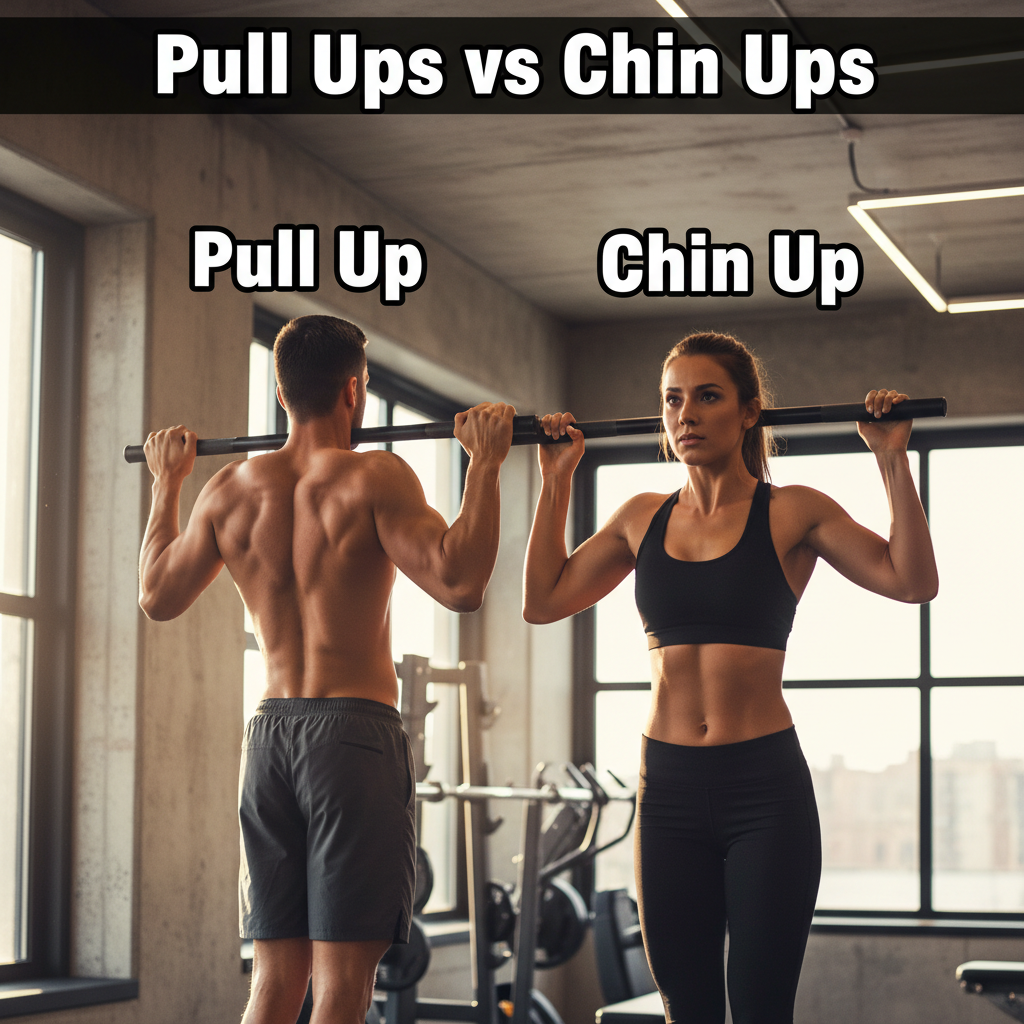
| Grip | Overhand (pronated), wider than shoulders | Underhand (supinated), shoulder width or closer |
| Main Muscles Worked | Lats, upper back, traps | Lats, biceps, lower traps |
| Biceps Involvement | Moderate | High |
| Difficulty | Harder | Easier for most |
| Common Uses | Strength, back width | Muscle building, arm strength |
| Recommended For | Athletes, advanced trainees | Beginners, muscle growth |
What Are Pull Ups and Chin Ups?
Pull Ups – Proper Form, Variations, and Typical Uses
Pull ups use an overhand grip with hands wider than shoulders. Hang from a bar, engage your back, and pull your chin to the bar. Common variations: wide grip pull ups, commando pull ups, and weighted pull ups. Typical uses: build upper back strength and test real-world pulling ability.
Chin Ups – Proper Form, Variations, and Typical Uses
Chin ups use an underhand grip, about shoulder-width or closer. Start from a dead hang, pull your chin above the bar, focus on squeezing biceps and lats. Variations include close grip, mixed grip, and weighted chin ups. Common in muscle growth programs and arm-focused routines.
Pull Ups vs Chin Ups: Grip, Mechanics, and Muscle Activation
Hand Position and Biomechanics Explained
Pull ups use a pronated grip (palms away) shifting effort to the upper back and lowering biceps contribution. Chin ups use a supinated grip (palms toward you) increasing biceps and scapular involvement. Range of motion in chin ups can be slightly longer for most.
Target Muscles: Lats, Biceps, and Beyond
- Pull Ups: Focus on latissimus dorsi, trapezius, rhomboids, teres major, and some biceps.
- Chin Ups: Lats plus strong activation in biceps brachii, brachialis, and lower traps.
- Both: Engage core, forearms, and grip muscles.
Electromyography (EMG) and Science Insights (2026 Research)
Recent EMG studies (2026) show chin ups activate biceps 20% more than pull ups. Pull ups activate upper lats and lower traps by 15% more. Both exercises outperform lat pulldowns in total muscle recruitment. Science confirms both are effective compound movements, but emphasis varies by grip.
Pull Ups vs Chin Ups for Strength, Muscle Growth, and Endurance
Training for Hypertrophy: Which Builds More Muscle?
Chin ups favor muscle growth in arms due to stronger biceps activation. Pull ups target back width and density. For hypertrophy, combine both for best results. Data show routines with both yield 8-12% more upper body mass gains versus one alone.
Strength and Functional Performance: What the Data Shows
Pull ups develop upper body strength relevant for climbers, athletes, and service members. Chin ups help lifters improve arm and grip strength, aiding compound lifts like rows and deadlifts. Testing shows average adults can rep 15-25% more chin ups than pull ups, highlighting pull up difficulty.
Endurance, Volume, and Rep Ranges Compared
Chin ups allow higher reps per set for most. Pull ups suit lower-rep, strength-based programs better. Studies note athletes perform on average 3-5 more chin up reps compared to pull ups at bodyweight.
Practical Programming: How to Use Pull Ups and Chin Ups in Your Routine
Sample Programs for Beginners, Intermediates, and Advanced
- Beginners: Assisted chin ups, negative reps. 2-3 sets, 5-8 reps per set.
- Intermediates: Alternate pull ups and chin ups each session. Add resistance bands or weighted sets. 3-4 sets, 6-10 reps.
- Advanced: Use weighted pull ups, pause reps, and slow eccentrics. 4-5 sets, 5-8 reps.
Integration for Sports, Crossfit, and Calisthenics
- Sports: Prioritize pull ups for functional pulling strength.
- Crossfit: Rotate pull up and chin up variations for balanced development.
- Calisthenics: Mix grips, add isometric holds, and muscle ups for progression.
Choosing Based on Fitness Goals: Fat Loss, Aesthetics, or Athletics
- Fat Loss: Both are calorie-burning, compound, and efficient for high-rep circuits.
- Aesthetics: Use chin ups for biceps, pull ups for V-taper and back width.
- Athletics: Pull ups for strength, chin ups for muscle building and grip endurance.
Progressions, Regression, and Troubleshooting
Step-by-Step Progressions for Pull Ups and Chin Ups
- Dead hangs and scapular pulls
- Assisted reps (bands/machines)
- Negative reps (slow eccentrics)
- Full bodyweight repetitions
- Weighted variations
Common Mistakes and How to Fix Them
- Swinging: Control movement, start from dead hang.
- Partial reps: Lower to full extension at the bottom.
- Neck craning: Pull with chest, avoid straining neck.
Injury Prevention and Safe Training Tips
- Warm up shoulders and wrists.
- Progress slowly; avoid adding excessive weight too soon.
- Rest elbows and shoulders if pain occurs.
Pull Ups vs Chin Ups for Different Populations
Women, Older Adults, and Athletes: Special Considerations
Women benefit from chin ups due to better leverage and higher rep potential. Older adults should start with assisted variations to avoid joint stress. Athletes needing pulling strength should integrate both.
Adaptive Training for Various Body Types and Limitations
- Heavier individuals: Use machines, slow eccentrics to build base strength.
- Shoulder issues: Use neutral grip or ring pull ups to reduce strain.
- Mobility limits: Focus on partial range or isometric holds.
Frequently Asked Questions (FAQ) about Pull Ups vs Chin Ups in 2026
- Which is better for beginners? Chin ups, thanks to higher biceps involvement making reps easier.
- Can I do both in my routine? Yes, this approach builds balance and prevents overuse.
- Do I need equipment? A sturdy pull up bar is essential. Some portable options are available online—see below.
- How many per week? 2-3 times weekly with 48 hours rest between sessions is optimal.
Expert Insights and Real-World Advice
Quotes from Coaches, Physios, and Strength Athletes
- “For broad strength, pull ups are king. For total development, alternate both.” – Coach Tyler Grant (2026)
- “Chin ups are a powerhouse for arms, but don’t skip pull ups if you want back width.” – Dr. Serena Hill, Physio
- “Master both. Each offers unique benefits for climbing, calisthenics, and lifting.” – Pro Athlete Jordan Li
When and Why to Prioritize Each Movement
- Pull ups: Focused back training, athletes, military prep.
- Chin ups: Arm hypertrophy, beginner strength, variety in home workouts.
References and Further Reading: Science, Tutorials, and Pro Tips for 2026
- 2026 EMG Research: “Grip Type and Muscle Activation in Pull Ups and Chin Ups” – Journal of Sports Science
- Watch form tutorials (YouTube)
- Best Pull Up Bars for Home (Amazon.com—Shop Here)
- More advanced calisthenics tips at Reddit Bodyweight Fitness
- Ready to start? Get a pull up bar today and transform your training in 2026.