Why Push Ups Matter: Benefits for Strength and Everyday Fitness
Science-Backed Advantages of Push Ups
Push ups are one of the best bodyweight exercises. They help you build upper body strength, improve endurance, and boost your overall fitness. Studies show that push ups increase muscle strength, protect your heart, and support healthy bones. They do not need any special equipment, so you can do them anywhere.
Muscles Worked During a Push Up
When you do a push up, you use several muscles at the same time:
- Chest (pectorals): Main muscle used in every push up
- Shoulders (deltoids): Help move your arms up and down
- Triceps: Support arm movement and strengthen your arms
- Core muscles: Keep your body stable and strong
- Back: Supports good posture and balance
At-Home Fitness Trends and Push Ups in 2026
In 2026, more people choose at-home exercises. Push ups are still a trend because they are easy, flexible, and free. Many online coaches and fitness apps use push ups in their beginner and advanced plans.
How to Do a Push Up Properly: Step-by-Step Instructions
Setting Up for Success: Proper Positioning
- Find a flat surface. Use a mat if hard floors hurt your hands.
- Kneel and place your hands on the floor, a bit wider than shoulder-width.
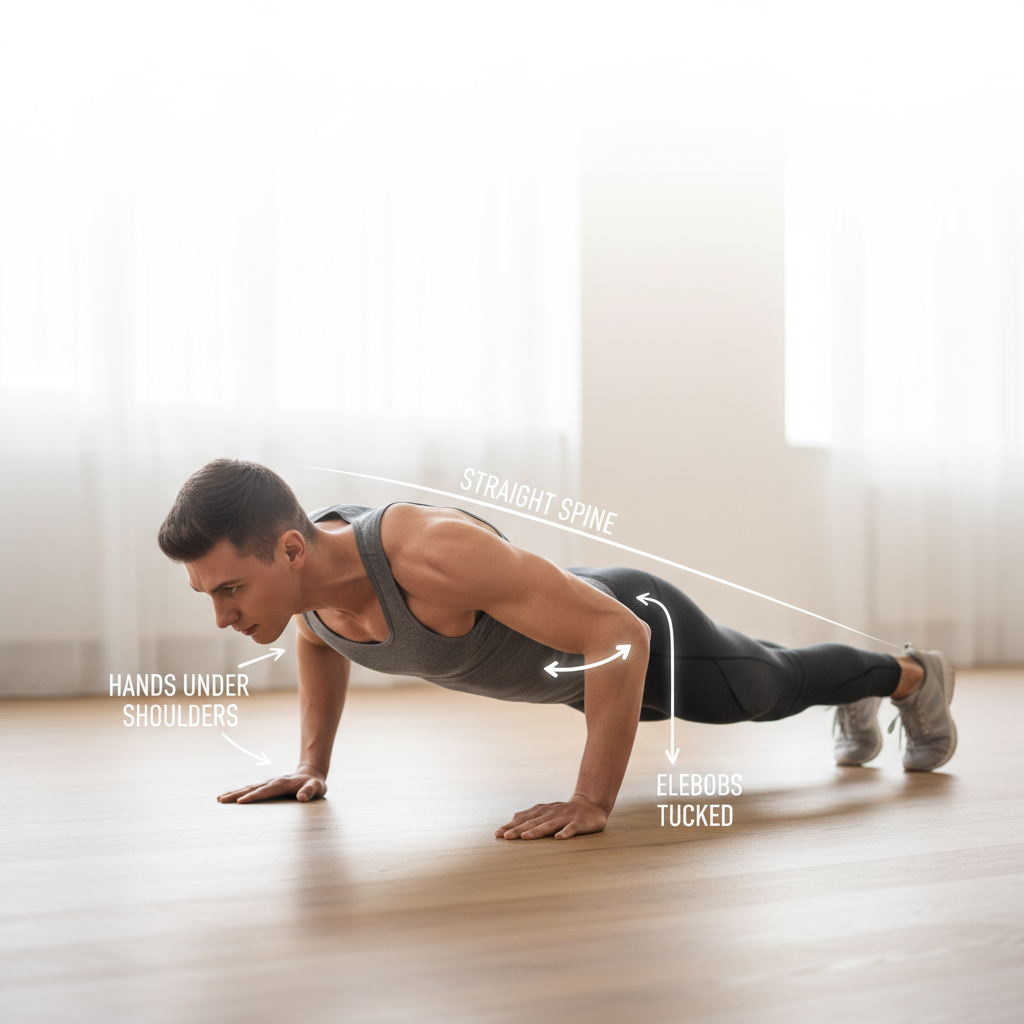
- Step your feet back until your body forms a straight line from head to heels.
- Keep your feet about hip-width apart for stability.
Executing the Perfect Push Up: Form Cues and Technique
- Look down to keep your neck straight.
- Tighten your core and glutes to keep your body in a straight line.
- Slowly lower your body by bending your elbows until your chest almost touches the floor.
- Keep your elbows at about 45 degrees from your body.
- Push through your hands to return to the starting position.
- Repeat for as many reps as you can with good form.
Common Mistakes to Avoid for Push Up Safety
- Letting your hips drop or rise too high
- Flaring your elbows out too wide
- Not using a full range of motion (not going low enough)
- Forgetting to tighten your core
Push Up Progressions: Modifications for Every Level
Absolute Beginner: Wall and Incline Push Ups
- Stand facing a wall and place your hands on it, shoulder-width apart.
- Step back and lean toward the wall, doing a push up against it.
- Try an incline push up by placing your hands on a chair or bench instead of the floor.
Building Strength: Knee and Partial Push Ups
- Start on your knees instead of your toes.
- Lower your chest toward the ground, then push up.
- Try partial push ups, where you only go halfway down, until you get stronger.
Standard Push Up: Achieving Full Range of Motion
- Move to full push ups when you can do 10–15 knee push ups easily.
- Keep practicing form and depth each rep.
Advanced Push Ups: Diamond, Decline, and One-Arm Variations
- Diamond Push Ups: Make a diamond shape with your hands under your chest.
- Decline Push Ups: Put your feet on a chair to make it harder.
- One-Arm Push Ups: Only for advanced athletes—use one arm at a time.
Push Up Myths and Facts: Busting Common Misconceptions in 2026
“Knees on the Floor Are Cheating” – Truth or Myth?
This is a myth. Knee push ups help beginners build strength safely. They are a great way to develop proper form before moving to standard push ups.
Do Push Ups Hurt Your Joints?
Push ups are safe if you use good form. If you feel pain, check your movement and try easier variations. Don’t rush. If you have health issues, talk to your doctor before starting.
Can You Build Muscle with Just Push Ups?
Yes, you can build muscle and get stronger with push ups. Try harder variations and higher reps as you improve.
Push Up Plateaus and Troubleshooting: How to Keep Progressing
Recognizing and Overcoming Push Up Plateaus
A plateau happens when you stop getting stronger or can’t do more reps. To break through, try new push up types, take less rest, or add sets.
Tips for Faster Improvement
- Do push ups regularly (3–4 times a week)
- Focus on slow and controlled movements
- Track your sets and reps each workout
- Get enough rest and eat well to help your muscles recover
Accessory Exercises to Boost Your Push Up Strength
- Planks for better core strength
- Tricep dips to strengthen your arms
- Shoulder taps for better stability
- Bench presses if you have access to equipment
Injury Prevention and Safe Push Up Practice
Protecting Your Wrists, Shoulders, and Lower Back
- Warm up your joints before doing push ups
- Use a padded mat to reduce stress on your wrists
- Keep your back and stomach tight to avoid straining your lower back
Push Ups for People With Previous Injuries
If you have had injuries, start with wall push ups or knee push ups. Stop if you feel pain. See a doctor or physical therapist for personalized advice before doing push ups.
Warm-Up and Cool Down Routines for Safe Training
- Warm up with arm circles, shoulder rolls, and jumping jacks for 5–10 minutes.
- After workout, stretch your arms, chest, and back for 5–10 minutes to help muscles recover.
Tracking Your Push Up Progress in 2026
Interactive Checklists and Progress Charts
Write down your daily push up numbers in a notebook or print out a progress chart. Check off goals as you reach them.
Using Fitness Apps and AI Tools for Motivation
Fitness apps now use AI to track your progress, give you reminders, and suggest ways to improve. Many apps show your stats and keep you motivated with challenges and awards.
Setting Realistic Goals and Staying Accountable
- Set a goal, like “20 push ups in a row.”
- Break big goals into small steps and track your progress.
- Share your plan with friends or family to help you stay motivated.
Frequently Asked Questions About Push Ups
- How often should I do push ups?
- What if I can’t do one push up yet?
- Should I do push ups fast or slow?
- Can push ups help me lose weight?
- How long will it take to see results?
For most people, doing push ups 3–4 times a week is enough. Start with the easiest version you can do. Move slowly and focus on good form. Push ups help with strength, not just weight loss. With steady practice, you’ll see progress in 4–8 weeks.
Summary: Your Roadmap to Push Up Mastery in 2026
Push ups are a simple and effective way to get stronger at home. Follow the steps in this guide to learn good form, avoid injuries, and make steady progress. Try different push up types, track your results, and use tech tools to stay on track. With regular practice, you’ll master the push up and build a strong, healthy body.