Why Focus on Bodyweight Bicep Exercises?
Benefits Over Traditional Weight Training
Bodyweight bicep exercises offer many benefits. They do not require dumbbells, barbells, or machines, so you can train anywhere. These exercises improve strength using your own body. They also help develop balance and coordination. You lower the risk of injury caused by heavy weights. For students or beginners, bodyweight exercises are low-cost and safe.
Who Should Choose Bodyweight Bicep Workouts?
Bodyweight bicep workouts are perfect for students, teens, and anyone with limited access to gym equipment. They suit beginners, athletes, and people looking to build strength at home, outdoors, or on the go. If you want to avoid heavy weights or simply want variety, these exercises are ideal. They help you build muscle, tone arms, and increase endurance.
Anatomy of the Biceps and Optimal Bodyweight Activation
Bicep Function and Engagement in Calisthenics
The biceps are two-headed muscles on the front of your upper arm. Their main job is to bend your elbow and rotate your forearm. In bodyweight exercises, your biceps work with your back and shoulders to pull your body up or hold it steady. With proper form, bodyweight moves can activate biceps as well as weights or machines.
Common Mistakes When Training Biceps with Bodyweight
- Using only arms instead of engaging the back and shoulders, leading to poor technique.
- Not performing the full range of motion, which limits muscle growth.
- Using momentum or swinging, which reduces bicep work and may cause injury.
- Skipping warm-ups or overtraining without adequate rest.
Essential Warm-Up for Safe and Effective Bicep Training
Dynamic Mobility Drills
- Arm Circles: Stand tall and swing arms forward and backward in big circles, 10 times each direction.
- Shoulder Rolls: Lift shoulders up, then roll them back and down, 10 times. Repeat forward, 10 times.
- Scapular Pulls: Hang from a bar or doorway. Without bending elbows, shrug shoulders up, then lower, 10 reps.
- Wrist Rotations: With arms at your side, rotate wrists clockwise and counterclockwise, 10 times each.
Injury Prevention Tips
- Warm up for at least 5-10 minutes before training.
- Focus on slow, controlled movements.
- Stop if you feel sharp pain.
- Cool down with stretching after workouts to keep muscles flexible.
Top Bodyweight Bicep Exercises (with Step-by-Step How-To)
Chin-Ups (Traditional, Close Grip, Negative)
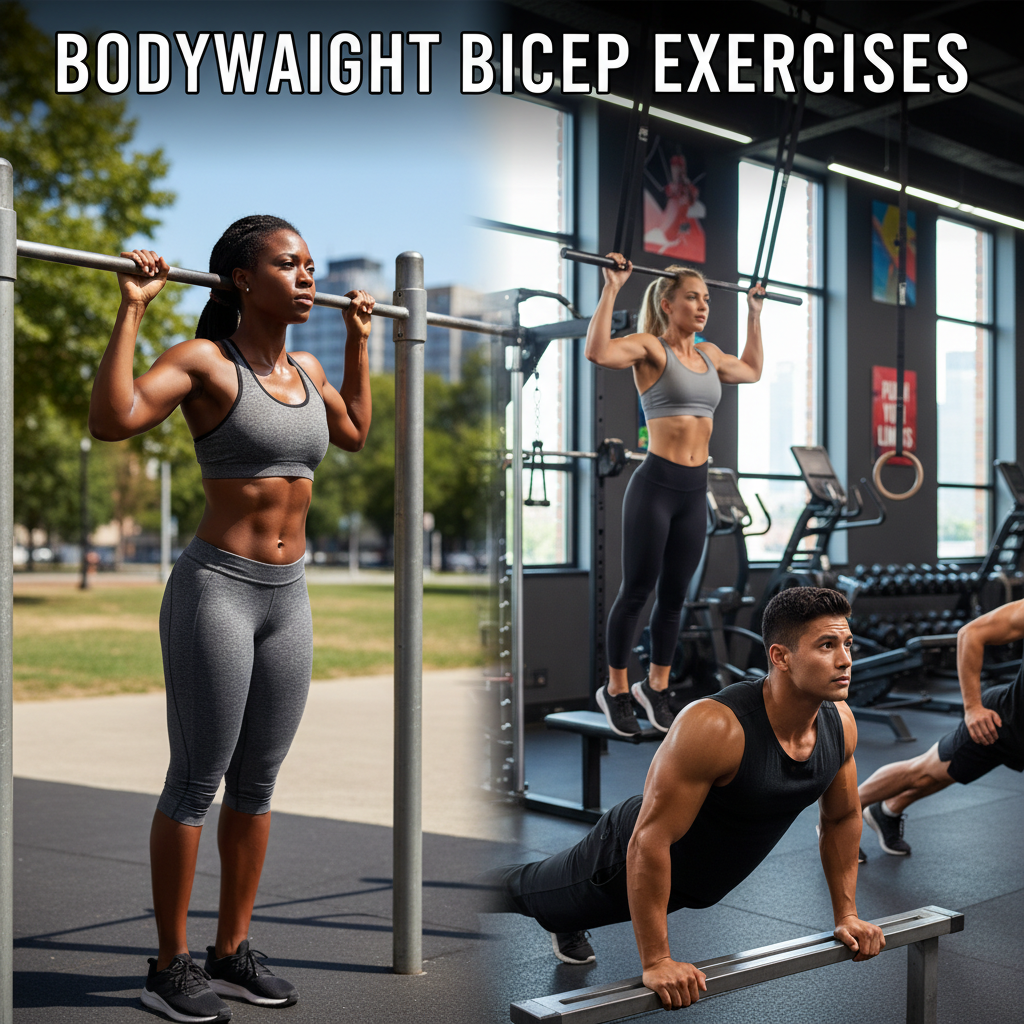
- Stand under a sturdy bar. Grasp the bar with palms facing you, hands shoulder-width apart.
- Hang with arms straight. Pull your chest up to the bar by bending elbows and squeezing biceps.
- Lower slowly back to straight arms. Repeat for target reps.
- For close grip, place hands 4-6 inches apart. For negatives, jump up to the chin-over-bar position, then lower as slowly as possible.
Australian Pull-Ups/Inverted Rows
- Set a low bar at waist-height. Lie underneath and grab it with palms facing you.
- Keep heels on the ground and your body straight.
- Pull your chest to the bar, squeezing your biceps and upper back.
- Lower with control, then repeat.
Bodyweight Curls (with Towel, Rings, or TRX)
- Hang a strong towel over a door or use gym rings/TRX straps at chest height.
- Hold handles or both ends of the towel. Step back so your body leans away and arms are straight.
- Keeping elbows high, curl your body toward your hands by bending elbows and flexing biceps.
- Lower with control, keeping elbows pointed up.
Isometric Holds and Static Contractions
- Grab a pull-up bar or towel and hold your body with elbows at 90 degrees, chin above the bar.
- Squeeze the biceps hard and hold as long as possible.
- Try wall sits for arms: Press palms into a wall as if trying to bend your elbow, hold for 20-30 seconds.
Advanced Variations (One-Arm Chin-Ups, Archer Pull-Ups, Typewriter Pull-Ups)
- One-Arm Chin-Ups: Perform chin-ups using one arm at a time for maximum challenge.
- Archer Pull-Ups: Pull up with most of your weight on one arm while the other stays straight, alternating sides.
- Typewriter Pull-Ups: Pull yourself chin-up, then move your body side to side at the top before lowering.
Creating Your Customized Bodyweight Bicep Workout
Training Frequency and Volume for Best Results in 2026
- Beginners: 2-3 days a week, 1-2 bicep exercises, 2-3 sets of 6-10 reps per exercise.
- Intermediate: 3-4 times a week, 2-3 exercises, 3-4 sets of 8-15 reps.
- Advanced: 4-5 times a week, 3-4 exercises, varied reps and intensity.
Progression Techniques (From Beginner to Advanced)
- Increase reps or sets over time.
- Use harder variations (move from inverted rows to chin-ups).
- Add isometric holds at the top or bottom of reps.
- Slow down your reps for extra muscle tension.
- Try advanced moves like one-arm work as you get stronger.
Adapting Workouts for Home, Gym, or Outdoor Use
- At home: Use a sturdy door, towel, or table for pulling exercises.
- At the gym: Use pull-up bars, rings, or TRX straps.
- Outdoors: Find playground bars, tree branches, or staircase railings.
Addressing Common Challenges in Bodyweight Bicep Training
Plateau Busting Strategies
- Change your exercise variations every 4-6 weeks.
- Focus on quality and slower reps instead of just more reps.
- Add holds at the most challenging points of the movement.
- Keep a workout log to track progress and set new goals.
Effective Recovery and Avoiding Overtraining
- Give muscles at least 1-2 days to rest between bicep workouts.
- Sleep 7-9 hours per night for recovery.
- Eat enough protein and drink water to support growth.
- Include gentle stretching or foam rolling after workouts.
Combining Bodyweight Bicep Exercises with Full Upper Body Routines
Integrating Push, Pull, and Core Movements
- Push exercises: Push-ups, dips, and triceps extensions.
- Pull exercises: Chin-ups, rows, curls (as listed above).
- Core exercises: Planks, leg raises, mountain climbers.
- Perform one push, one pull, and one core movement each session for balance.
Weekly Split Examples for Balanced Growth
| Day | Main Focus |
|---|---|
| Monday | Pull (Chin-Ups, Rows) + Core |
| Wednesday | Push (Push-Ups, Dips) + Core |
| Friday | Full Body (Mixed Push and Pull) + Core |
Frequently Asked Questions About Bodyweight Bicep Exercises
Can I build big biceps with bodyweight alone?
Yes. With proper progression, full range of motion, and high effort, you can build strong and visible biceps using only bodyweight exercises.
How long until I see results?
Most people notice improvements in strength and muscle tone within 4-8 weeks if they train regularly and eat well.
What if I can’t do a single chin-up yet?
Start with negative chin-ups, assisted chin-ups using bands, or do inverted rows. Progress step by step, and you will gain strength over time.
Best alternatives if I have no equipment
- Under-table rows: Lie under a sturdy table and pull your chest up.
- Doorway towel curls: Drape a towel over a closed door and use it for curls.
- Push-ups: While not a bicep isolation, they still help with overall arm strength.
Additional Resources and Next Steps for Bicep Progression in 2026
- Track your progress weekly in a notebook or app to stay motivated.
- Look for free online videos and exercise demos to improve your technique.
- Join online forums or communities for support and ideas.
- Try new variations regularly to challenge your muscles, avoid boredom, and avoid plateaus.
Bodyweight bicep exercises are a practical, effective way to build arm strength in 2026 and beyond. Now that you know the key movements, warm-ups, and progression, start your journey to stronger biceps today. Stay consistent, celebrate your progress, and remember – good form always comes first!